The Japanese Notebook: Why a Good Notebook Still Matters
In 2026, buying a notebook can feel slightly old-fashioned. We carry devices that can remember almost everything, search for anything and remind us about appointments before we have even forgotten them.
In 2026, buying a notebook can feel slightly old-fashioned. We carry devices that can remember almost everything, search for anything and remind us about appointments before we have even forgotten them. Yet I still find myself stopping in stationery shops to look at notebooks I probably do not need.
Perhaps you do the same.
I have always liked that moment just before a notebook becomes yours. The cover is still clean, the pages untouched, and there is a small but strangely serious question: what is actually worth writing on the first page? A phone does not quite give you that feeling. Opening a new document is useful. Opening a new notebook feels like beginning something.
This is perhaps one reason Japanese stationery has such a devoted following. Brands such as Midori have understood something that much of modern product design occasionally forgets: an everyday object does not have to be complicated to be beautifully considered. A good notebook can feel right in your hand, open properly, lie comfortably on a desk and, most importantly, make you want to write.
It sounds like a modest ambition. It is also surprisingly difficult to get right.
The pleasure of the everyday
Japanese stationery has a particular relationship with everyday life. Rather than turning a notebook into a luxury object, many Japanese manufacturers treat it as something that should quietly improve an ordinary routine. Midori is a good example. The company has been making stationery in Japan for decades, and its notebooks and paper products have a kind of understated intelligence that reveals itself through use.
The paper feels considered. The covers are uncomplicated. Details such as the binding, page layout and the way a notebook opens are treated as part of the experience rather than technical afterthoughts.
The result is not particularly loud.
You might even walk straight past it.
That is part of the charm.
I once bought a small notebook simply because I liked its proportions. It was not particularly expensive and I had no real plan for it. For several weeks it sat on my desk while I continued writing notes on scraps of paper, receipts and the backs of envelopes. Eventually, I started carrying it with me.
It became the place for things that did not belong anywhere else: the name of a restaurant someone had mentioned, a book I wanted to find, an idea for an article, a telephone number I knew I would otherwise lose. None of these things was particularly important on its own.
Together, they became a small record of a period of my life.
That is the curious thing about notebooks. You buy them empty, but they become valuable because they are eventually filled with things that cannot be bought.
Why Japanese notebooks feel different
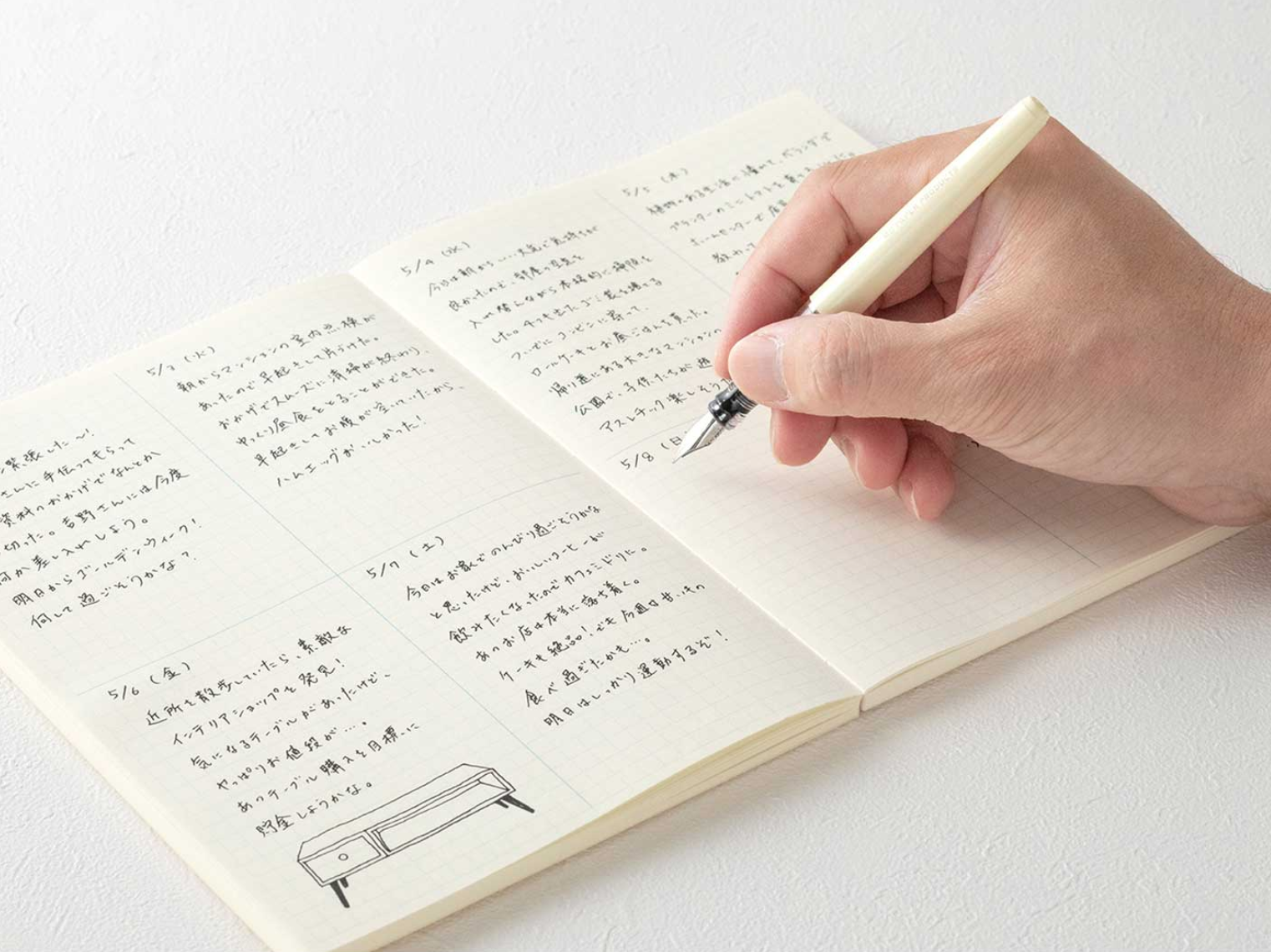
Part of the fascination comes from the paper itself. Japanese paper manufacturers have spent generations refining how paper behaves with different kinds of writing. The relationship between ink and paper is taken seriously, particularly among fountain-pen users, illustrators and people who still enjoy writing by hand.
There is a physical pleasure to it.
A pen moves differently across good paper. Ink settles into the surface rather than simply sitting on top of it. A pencil makes a softer sound. Turning a page becomes part of the rhythm of thinking.
These details can sound almost absurdly precious until you experience them.
Then you understand.
Midori's MD Paper notebooks are a particularly good example. The paper is designed to work beautifully with different writing instruments, while the notebook itself remains remarkably simple. There is no attempt to turn it into a lifestyle statement. It is simply a well-made notebook.
Other Japanese makers take different approaches. Traveler's Company's leather-covered Traveler's Notebook system is closer to a personal archive, while Kokuyo has built a reputation for practical, beautifully engineered stationery. Brands such as Life and Apica have developed notebooks that appeal to people who care deeply about paper quality and construction.
What they share is an interesting idea: stationery can be functional without being anonymous.
A notebook as a place
Perhaps the greatest difference between a notebook and a phone is not technological at all. It is psychological.
A notebook has a physical boundary.
When I open one, I know where I am. The previous page is behind me, the next one is waiting, and there are no notifications, open tabs or small reminders that I should be doing something else.
This makes notebooks surprisingly good places to think.
You can write badly. You can change your mind. You can cross something out without making it disappear. You can leave half a page empty simply because you have run out of things to say.
Digital tools are wonderfully efficient at producing clean results. Notebooks are better at preserving the mess that happens before an idea becomes useful.
That may explain why so many designers continue to sketch on paper even when their final work will exist entirely on a screen.
The first version of an idea does not need to be beautiful.
It simply needs somewhere to happen.
There is something reassuring, too, about the continued existence of carefully made stationery in an age when almost everything around us is being optimised for speed.
The best Japanese notebooks are not necessarily handmade page by page by a single craftsperson. Their appeal often lies in the accumulated knowledge behind the manufacturing process: paper selection, printing, folding, stitching, binding and quality control. Small decisions become noticeable when they are repeated thousands of times.
This is what makes Japanese craftsmanship so interesting. It is not always about making something visibly elaborate. Sometimes it is about removing the unnecessary until what remains feels almost inevitable.
A notebook should open.
A page should turn.
A pen should not fight the paper.
A cover should survive being carried around.
These are simple requirements. Yet when they are done properly, they become a kind of quiet luxury.
Perhaps that is why a good Japanese notebook can feel more satisfying than a much more expensive object. It does not ask to be admired.
It asks to be used.
What we leave behind
There is another reason I keep buying notebooks despite having more digital tools than I could possibly need.
They remember differently.
Years later, a notebook can return you to a particular afternoon with remarkable accuracy. You see the handwriting becoming larger because you were in a hurry. A coffee stain sits beside a telephone number. A page is filled with an idea that never went anywhere. There is a name you have forgotten and a restaurant that no longer exists.
A digital archive can store far more information. A notebook can preserve the circumstances in which that information mattered.
Perhaps this is the real pleasure of Japanese stationery. It is not nostalgia for a world before technology. It is a reminder that technology does not have to replace every small physical pleasure simply because it can.
There is still something wonderful about choosing a notebook, putting it in a bag and carrying it through the city. You may use only three pages in a week. You may fill twenty in an afternoon. You may eventually lose it beneath a pile of books.
But while it is with you, it becomes a small, private room.
And unlike most rooms, you can carry it home in your coat pocket.
jetpens/youtube
Away from the noise.
Only the content that interests you, away from the noise and calm. Subscribe to our curated newsletter.